Painting Kitchen Cabinets or Replacing Them: What Each Path Involves
If your cabinet boxes are sound and your layout works, a careful paint job changes the whole kitchen.
October 21, 2026 · 4 min read
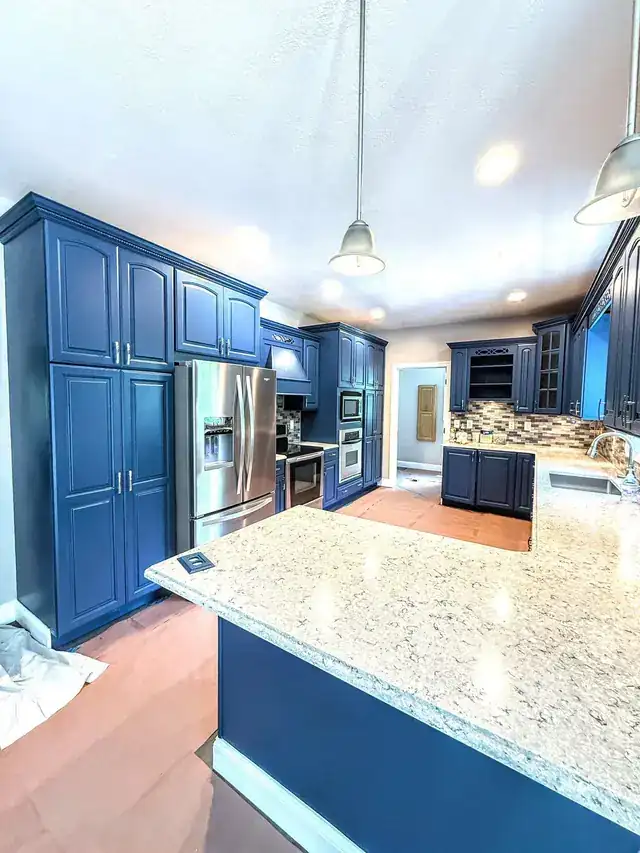
A tired kitchen usually has one obvious culprit: the cabinets. They take up more visual space than anything else in the room, so when the finish is worn, yellowed or simply not your style, the whole kitchen feels dated. That leaves a real decision. You can have the cabinets you own refinished, or you can tear them out and start over. Both are legitimate, and the right answer depends on what is actually wrong.
When does painting make sense?
Painting is a strong choice when the cabinet boxes are structurally sound, the doors close properly and the layout already works for how you cook. In that case, the problem is surface, and a surface can be fixed. Solid wood doors and good panel doors paint well.
Painting also lets you keep the kitchen you know. The counters stay, the plumbing stays, the footprint stays, and the work happens inside your house without demolition.
When is replacing the better call?
Replacement makes sense when the layout itself is the problem. If you need an island that does not fit, a pantry wall that does not exist or a work triangle that wastes steps, no paint will fix that. The same goes for boxes that have swollen from water damage under a sink, shelves that sag, or doors and frames that have warped past the point where they hang straight.
Be honest with yourself about this before spending anything. Fresh paint on cabinets that were failing for structural reasons only hides the trouble for a while. A good painter will tell you when the boxes are not worth finishing, and that candor is part of what a free estimate should give you.
What does the prep involve?
Prep is most of the job. Cabinets collect cooking grease and hand oils, and paint will not hold on a surface like that. The doors and drawer fronts come off, usually numbered so they return to the right opening, and the hardware comes off with them. Everything gets degreased and cleaned, then sanded or scuffed so the primer can grab.
- Clean and degrease every surface that will be painted.
- Remove doors, drawer fronts and hardware, and label each one.
- Fill dents, old hardware holes and open grain where needed.
- Sand or scuff, then prime before any color goes on.
Floors, counters and nearby furniture need to be protected before any of it begins. We provide full floor and furniture protection on every job, because sanding dust and overspray travel farther than people expect.
How do spray, brush and roll each help?
A good cabinet finish usually uses more than one method, because each one does a different job well. Spray application gives the smoothest result on flat door faces and drawer fronts, with no brush marks and an even film. Brush application handles the detailed work: the edges of raised panels, the inside corners and the face frames where a sprayer is hard to control. Roll application covers the larger flat surfaces, such as end panels and the sides of an island, with a fine finish.
The point is not to pick the single best tool. It is to match the tool to the surface. A kitchen done entirely with a brush can show strokes on large flat doors. Using all three, in the right places, is how you get a finish that looks factory-made instead of painted.
What do dry time and cure time mean?
Paint that feels dry is not necessarily cured. Dry to the touch means the surface has stopped being tacky. Cured means the film has hardened enough to stand up to bumps, wiping, hinges and hands. The gap between the two is real, and cabinets are the hardest-working painted surface in your house.
Cure time depends on the product, the room's temperature and humidity, and how thick the coats are. We will not promise you a number of days that the paint itself has not agreed to. What we can tell you is the practical advice: go gently with the doors and drawers for a while after they are rehung, avoid stacking things against fresh finish, and hold off on harsh cleaners until your painter says the surface is ready.
How do you choose the color and the hardware?
Cabinet color carries more weight than any other choice in the kitchen. A deep navy or charcoal makes a strong statement against light counters, while crisp white keeps a smaller kitchen open. Try a large sample on a spare door, and look at it near the stove and by the window, because kitchens have some of the most mixed lighting in the house.
New pulls can change a painted kitchen as much as the color does, and old holes need to be filled or reused. Decide on hardware before the prep starts, so the holes are dealt with once.
If your cabinets are sound and you would like them to look new, the kitchen cabinet painting page explains how we plan the job, from the first consultation through spray, brush and roll work. Dana provides free, detailed, itemized estimates, and you can reach us at (412) 205-8263 to set up a look at your kitchen.
All Interior Painting, (412) 205-8263
Call (412) 205-8263More articles
How to Choose an Interior Paint Color in the Room Itself
A small card under store lights tells you very little, so the room itself has to do the judging.
Panel Molding, Wainscoting and Board-and-Batten: What Each One Is and Where It Fits
Three trim styles that look alike in photos, and three very different answers to a blank wall.